Documenting Forensic Facial Reconstruction: Bringing the Barnum Museum’s Mummy to life

Updated: Oct 4
Last week I traveled to New York City to document a rare process that museums almost never get to capture in real time: a forensic facial reconstruction in progress.
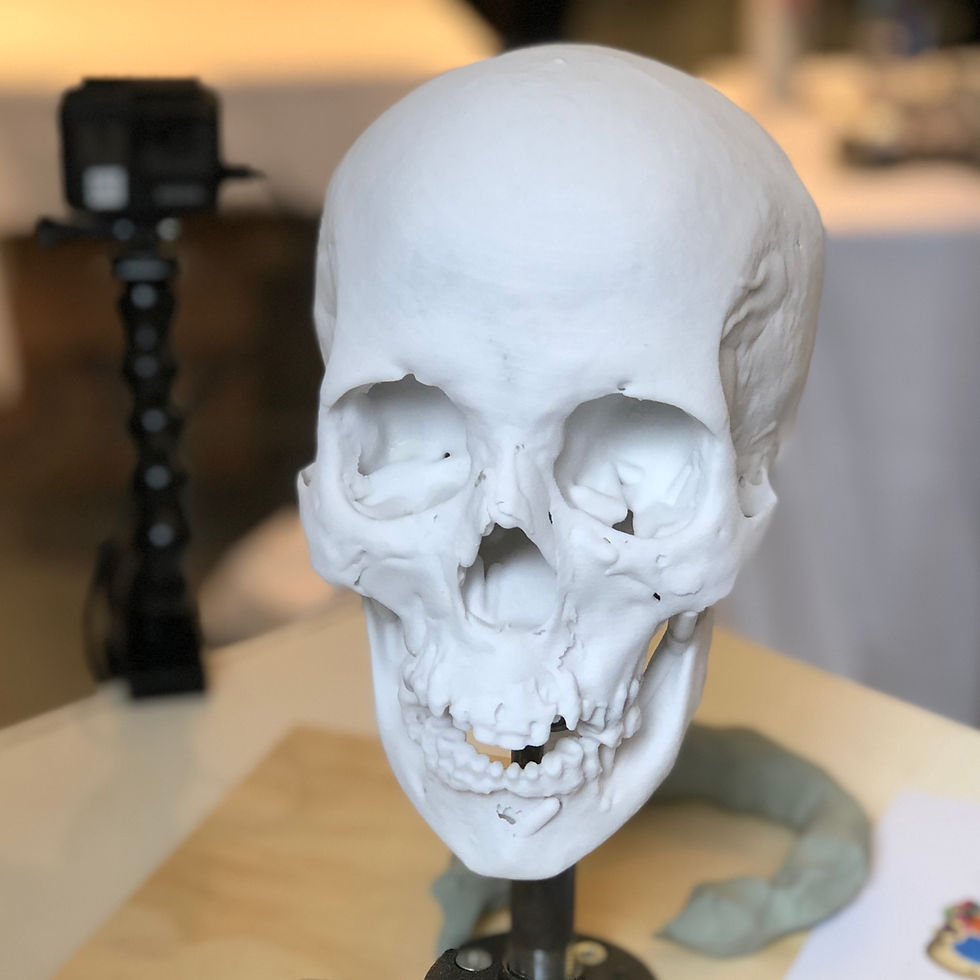
The Barnum Museum’s Egyptian mummy has been part of the collection since the late 1800s. This project was not about spectacle. The goal was to return a sense of personhood - to help audiences encounter her as an individual who lived a life, rather than defining her only by death and mummification.

As RPCreative, I focus on documentation that institutions can actually reuse - for interpretation, education, fundraising, and long-term archival value. This project is a good example of that kind of work.
What happened at the workshop

The reconstruction took place during a week-long workshop at the New York Academy of Art led by forensic imaging specialist Larry N. “Joe” Mullins. Using a 3D print of the woman’s skull as the base, he built the face layer by layer: facial musculature first, then skin, then the refinement of features and hair in plasticine.
This is one of those shoots where “what are we filming today?” requires a slightly longer answer than usual.
I documented the work as it unfolded, alongside videographer William Sarris (William Sarris Productions), capturing the transformation step by step and in a form the Museum can repurpose across programs and platforms.
Why Forensic Facial Reconstruction Documentation Matters for Institutions

For museums, historical societies, universities, and cultural nonprofits, the most valuable part of a project like this is the process - the decisions, sequencing, and expert methods that you cannot recreate once the work is finished.

That is why the documentation matters. It creates usable assets that can support:
exhibit and gallery interpretation
education and public programs
development and donor communications
institutional archives and future research
grant reporting and future proposals
For funders and grant reviewers, strong documentation becomes part of the evidence trail: it shows the work happening, demonstrates public-facing value, and helps connect outcomes back to the original goals.
The two-minute highlight, and what comes next
The two-minute video, “Face to Face: Forensic Facial Reconstruction of the Barnum Museum’s Mummy,” is a short visual overview of the reconstruction process. There is no dialogue, and that is intentional - it allows the Museum to use the piece flexibly in gallery settings, presentations, and online.
It also serves as a preview of a larger project in development that will incorporate additional expert perspectives, expanding the story beyond the studio and into deeper historical and scientific context.
What changes when the face becomes recognizable

A skull print is clinical. Once the features become recognizable, the way people read the subject changes.
The reconstruction gives audiences more visual information to work with and helps move interpretation away from an anonymous object and toward an individual life. It also changes the camera operator’s job considerably. A skull does not have a particularly strong opinion about its good side. That balance—clear documentation, stronger context, and respectful interpretation—is what the project was built to support.
If your museum or cultural organization is exploring a similar project—or needs to document complex work clearly, respectfully, and in a format built to last—I’m open to discussing the right approach. For details, Get in Touch.


Comments