From the Road to the Hall of Fame: The Videos Are Finally Here
Updated: 21 hours ago
Finishing our 2026 Wireless History Foundation project, from the editing room to the awards ceremony.

saying it was now just me, the footage, and an editing timeline between here and October.
Well, October came.
And I'm happy to report that the videos got finished, everyone made it to Washington, DC, and I survived another extended relationship with Adobe Premiere Pro.
After spending much of the summer traveling with my friend and fellow filmmaker Will Sarris to interview this year's Wireless Hall of Fame inductees and the people who knew them, it was time to turn all those conversations into something audiences could actually watch.
We had hours of interviews, historical photographs, archival footage, and five remarkable careers to help celebrate.
I was responsible for editing the induction films for Craig Snyder and Jim Bugel.
Now came the easy part.
Just kidding.
Ten Minutes of Story. Four Minutes to Tell It.
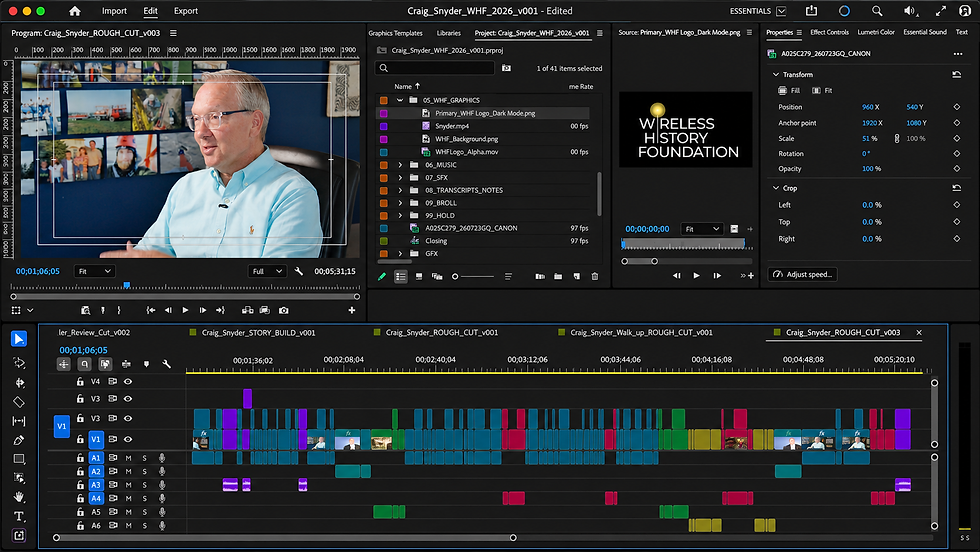
My editing process usually begins by going through the interviews, identifying the strongest material, and building what I consider the best version of the story.
That version typically runs around ten minutes.
The problem is that these induction films need to be closer to four minutes and twenty seconds.
So after spending considerable time figuring out what belongs in the film, I get to spend even more time figuring out what I can remove.
And that's where things get interesting.
The challenge isn't simply making a shorter video. It's figuring out which moments are essential to understanding someone and which, despite being fascinating, don't help tell the particular story we're trying to tell.
Sometimes a thirty-second anecdote can explain more about a person than several minutes of professional accomplishments.
Sometimes a short comment from a colleague becomes the moment that ties everything together.
And sometimes I spend twenty minutes moving a clip around the timeline before deciding it was better where I originally had it.
I'd like to say that last one is rare.
Then there's the archival research.
Finding the right photographs, historical footage, and documents is often one of the most time-consuming parts of the process. It's not enough to find something that looks good. It needs to accurately support what's being said.
Fortunately, I enjoy history, which makes this part of the job both fascinating and occasionally a very effective way to lose an entire afternoon.
Two Very Different Stories
Craig Snyder and Jim Bugel presented two different challenges.
Craig's career began climbing communications towers and eventually led to decades of work improving tower safety, standards, and professionalism throughout the industry.
His interviews included some remarkable stories, ranging from a serious tower collapse that helped shape his commitment to safety to an incident involving a cellphone falling approximately 350 feet from a tower.
The phone survived.
Craig still has it.

Naturally, we had to do something with that story.
It became a short, humorous walk-up video, while his longer induction film explored the experiences and people that shaped his contributions to the industry.
One of my favorite elements of Craig's induction film was the opportunity to incorporate archival footage of Bill Carlson, a fellow wireless pioneer who had passed away.
Bill had been an important part of Craig's professional life, and hearing his voice added something that another photograph or piece of narration simply couldn't.
Jim's film presented a different kind of challenge.
His career connects decades of commercial wireless experience with the creation and development of FirstNet, the nationwide communications network dedicated to America's first responders.
Explaining the history behind FirstNet in a few minutes isn't particularly easy, especially when you want the film to make sense to people who don't work in telecommunications.
But Jim's interviews gave us a way into the story through his personal experiences, including the communications challenges surrounding September 11.
Another fascinating element came from Morgan O'Brien, who described once considering Jim an adversary during a major spectrum dispute.
Years later, they had become friends.
Those human connections helped turn a complicated history into something more personal.
That's really the part of documentary editing I enjoy most: discovering how the separate interviews connect and figuring out how to make those connections meaningful for someone who wasn't there.
Here's What All That Editing Produced
Rather than spend another few paragraphs describing the films, I'd much rather let you watch them.
These are the two induction profiles I edited for the Wireless History Foundation's 2026 Hall of Fame.
Craig Snyder — 2026 Wireless Hall of Fame
From climbing towers to helping change how the industry approaches safety, Craig's story shows how a few pivotal experiences can influence an entire career.
Jim Bugel — 2026 Wireless Hall of Fame
Jim's story brings together the people, decisions, and experiences behind FirstNet, including an unexpected friendship that helped give the film its narrative structure.
Both films were part of a larger series produced with Will for the Wireless History Foundation, honoring all five members of the 2026 class: Brian Boyle, Jim Bugel, John DeFeo, Julius Knapp, and Craig Snyder.
Will and I have worked together on projects like these for years. One thing I appreciate about our collaboration is that we're always challenging each other to find better ways of presenting the material.
We don't necessarily agree on every creative decision, but that's part of what makes the process work.
Eventually, the edits are finished, the revisions are approved, and the videos are ready.
Which means it's time to load the equipment into the car again.
Back to Washington, DC
On October 4, Will and I headed back to Washington for the Wireless Hall of Fame ceremony at the Ritz-Carlton, Pentagon City.
Unlike some of our summer trips, we weren't there exclusively to record interviews for the induction films.
We also had a full production schedule surrounding the event, including additional interviews, a panel discussion, and coverage of the ceremony itself.

The panel explored where wireless technology might be heading next, touching on everything from artificial intelligence and satellite communications to 6G and public safety.
It was an interesting contrast. We'd spent months documenting the people who helped build the industry, and now we were recording conversations about where it might go next.

One of my personal highlights was getting to interview Marty Cooper.
If you're unfamiliar with the name, Marty helped lead the development of the first handheld cellular phone and made the famous public demonstration call in 1973.
For someone who loves history, getting to sit across from a person who played such a pivotal role in something we all use every day was pretty incredible.
I was genuinely in awe.

And I would have happily spent another hour talking with him.
Unfortunately, we still had an awards ceremony to film, and apparently the rest of the production schedule wasn't going to rearrange itself around my curiosity.
The Best Part Was Watching Everyone Else Watch
That evening, the induction films were presented during the Hall of Fame ceremony.
I'd seen these videos more times than I could possibly count by then.

I'd spent hours reviewing interviews, tracking down photographs, adjusting edits, choosing music, making revisions, and trying to get every story down to its essential elements.
But watching them in a ballroom full of people was a completely different experience.
And this wasn't exactly a quiet crowd.
People were talking, celebrating, catching up with old friends, and generally enjoying themselves.

Then the videos started.
And the room quieted down.
That might not sound like much, but as an editor, it's one of the nicest things you can experience.
After spending so much time wondering whether a particular section works, whether a story makes sense, or whether you've managed to keep the audience interested, seeing people actually stop and pay attention is a pretty reassuring sign.
I was also there working as part of the crew documenting the event, so I got to experience that moment from both sides of the camera.
And, as often happens at these ceremonies, several of the inductees came over afterward to thank us for the work.
That means a lot.
These films aren't simply lists of professional accomplishments. They're personal stories, often told through the memories of friends, colleagues, and family members.
Knowing that the people we're honoring appreciate how those stories were presented makes all the time in the editing room worthwhile.
And That's a Wrap. Probably.
One of the things I enjoy about working with the Wireless History Foundation is that these projects don't necessarily end when the videos are finished.
The induction films serve an immediate purpose, but the original interviews preserve hours of firsthand stories and historical details that may have other uses in the future.
Even during the Hall of Fame trip, we were recording more conversations and adding to that history.
It's the kind of work I find particularly rewarding.
I get to meet interesting people, learn about subjects I might never otherwise explore, and help turn their experiences into something that can be shared with others.
And I get to do it alongside people like Will, with whom I've had the opportunity to collaborate on some genuinely interesting projects over the years.
When I finished my previous blog, I was staring at an editing timeline and wondering how I was going to make everything fit.
A few weeks later, I was in Washington, watching the finished films play in front of the people we'd made them for.
That's a pretty satisfying way to finish the story.
Of course, knowing how these projects tend to go, I wouldn't be surprised if there's another interview, another edit, or another trip somewhere in our future.
I'll keep a few batteries charged.
If you'd like to see more of the work I've done with the Wireless History Foundation over the years, I've put together a case study featuring the induction films, behind-the-scenes production photos, and some of the awards we've received along the way.
Have a Story Worth Telling?
Projects like this are a big part of what I do through Rui Pinho Creative: filming interviews, creating documentary-style videos, editing existing footage, and documenting live events.
If you know a museum, nonprofit, business, or organization that could use help with something similar, I'd appreciate you passing my name along.
And if you're working on a project yourself, I'd love to hear about it.

Comments