A Summer on the Road With the Wireless History Foundation
Updated: Oct 4

That’s a wrap, at least for now, on shooting this year’s Wireless History Foundation Hall of Fame videos.
I say “at least for now” because Murphy’s law dictates that the moment I publish a blog post announcing the end of the travel, another shoot will be added to the calendar. Consider this wrap provisional.
Over the past couple of months, Will Sarris and I traveled to Seattle, the Washington, D.C. area, Cape Cod, South Dakota, Ithaca and finally Burlington, Massachusetts. Some trips were for the main interviews with this year’s inductees. Others were to speak with colleagues, friends and people who could help tell different parts of their stories.

The long drives developed their own routine. One of us was usually looking for the next snack run. Dunkin’ Refreshers and McDonald’s Fruit Refreshers, especially Strawberry Watermelon and Mango Pineapple, became staples this year.
Will, meanwhile, treated the GPS less like a navigation tool and more like someone with a bad opinion that needed to be corrected.

We’re always thrilled when a trip takes us into Culver’s territory. South Dakota delivered this year. A frozen custard Concrete Mixer makes a long production day feel considerably more reasonable.
Every shoot brought the same basic routine. No one seems to arrange a living room with a two-camera interview in mind, which feels a little inconsiderate.
We unload the equipment, look at the room, politely rearrange someone’s furniture and set up the cameras, lights and audio. Then we look at what the cameras see and start making adjustments. During setup, a chair can move six inches and somehow become the most important decision of the day.

After the interview, we fit everything back into cases that always seem smaller than they were when we arrived.
For a project about wireless, we travel with a truly unreasonable number of cables.
The hotel rooms brought another challenge. Finding enough outlets to charge everything was always a crapshoot, and we became very good at deciding which hotel lamps were decorative enough to unplug.
By the time all the equipment was connected, the room usually looked less like somewhere to sleep and more like a charging station that happened to contain beds. When unplugging the lamps still was not enough, the bathroom outlets were recruited for camera batteries.
Somewhere between all the driving, charging and arguing with GPS directions, we also got to sit across from some genuinely interesting people.
The 2026 Wireless Hall of Fame class includes Brian E. Boyle, Jim Bugel, John E. DeFeo, Julius Knapp and Craig Snyder. Their careers touch everything from the early growth of cellular service and spectrum policy to tower safety and the creation of a nationwide public safety network.

Most of us use wireless technology every day without thinking much about how it got here. These interviews bring that history back down to the people who actually lived it.

A résumé can tell you what someone accomplished. Sitting down with them, and with the people who worked alongside them, helps explain how it happened, what almost went wrong and why any of it still matters.

That has been the most interesting part of the summer.
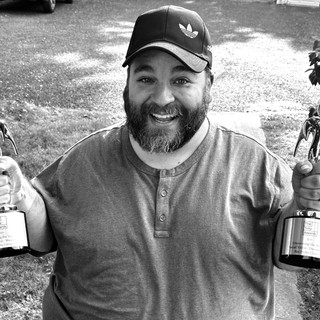
I had also planned to do a better job of appearing in the photos this year. My camera roll now contains hundreds of photographs and surprisingly little evidence that I exist.

Apparently being behind one of the video cameras or taking the photos myself makes that difficult.
The Final Wireless History Foundation Shoot With Lincoln
Our final scheduled shoot took us to Burlington for an interview with Paul Guidonis about Brian Boyle.
Will’s son Lincoln joined us as a production assistant. He helped bring the equipment inside and then jumped into setting everything up.
I stepped away for a few minutes to use the bathroom. When I came back, almost everything was ready and Lincoln was sitting in the interview chair so Will could get the lighting right. Having a third person made the setup move much faster.

I also came back to discover that I may have been replaced by a younger, faster crew member.
Lincoln took the behind the scenes photos from the day as well. Thanks to him, there is finally photographic evidence that I attended at least one of these shoots.

He got to see what Will and I are actually doing when we leave for one of these projects. He also got to see how much of filmmaking involves getting everything exactly right before asking everyone in the room to ignore all the equipment and have a natural conversation.
It was cool getting to share that experience with him. This is work that Will and I have done together for years, but Lincoln had never really seen the entire process up close.
For a project centered on preserving people’s work and legacies, ending the travel with the next generation behind the camera felt almost too perfect.
I’ll take it.
Now Comes the Editing
With the travel finished, I have organized the footage by inductee and am beginning the profiles of Craig Snyder and Jim Bugel.

Craig’s story follows a career that began with hands-on tower work. and grew into a larger effort to improve tower safety, standards and professionalism. Jim’s story connects decades of commercial wireless experience with the development and rollout of FirstNet for America’s first responders.
Now I have to take the main interviews, supporting perspectives, photographs, documents and other material and find the clearest path through each story.
That means a lot of listening, making choices, changing those choices and occasionally moving something around the timeline only to decide it was better where it started.
This quieter part of the project is where all those separate trips and conversations finally begin connecting.

History is not preserved simply because someone turned on a camera. The recording captures the memory. The editing provides the context that helps someone who was not there understand why that memory matters.
The finished profiles will introduce the inductees at the Wireless Hall of Fame Awards Dinner on October 5 at the Ritz-Carlton, Pentagon City.
The audience will see a few finished minutes for each person. They will not see the miles, hotel rooms, equipment cases or the many small decisions that went into those minutes.
If we do our jobs correctly, they will not be thinking about any of that. They will understand who these people are, what they contributed and why their stories are worth preserving.
Lincoln got to see the first half of that process.
Now it’s me, the footage and an editing timeline between here and October.
If your organization has people, milestones, or institutional history worth preserving, I’m open to discussing an interview-led project that can work both for an event and as a long-term archive. For details, Get in Touch.


Comments